Saturday, November 29, 2008

House on Swain’s Lane in London, Overlooks a Cemetery

I always knew those Brits are wicked, but not like that. Apparently on Swain’s Lane in London, there’s a glass looking house designed by London-based architects Eldridge Smerin, which has a great view, (prepare!!!) over a cemetery. Other than the fact that there are dead people in the area the four-storey house is extremely modern with large windows and doors made of glass to enhance space. Built on the footprint of the original 1970 house, it has two facadase. One is overlooking the cemetery and is mostly glazed while the other one is made of black granite, translucent glass and black steel panels, and overlooks the street. Looks extremely fancy but I’m not sure if I’d be able to live there. Would you? - via Dezeen

Friday, November 28, 2008

C-2 House by Curiosity Inc

Here is another amazing project designed by Curiosoty Inc The house is located in Yamanashi, Japan, and was build in 2006. Enjoy the photos.

Thursday, November 27, 2008

Geddes Residence Shines in West Vancouver

We’ve been covering wooden houses before, but we have something new for you today. Designed by Nigel Parish from the Canadian Architectural Design Studio Splyce, the Geddes Residence is a beautiful shining home with an irregular shape and view to the ocean, built in West Vancouver and surrounded by a very carefully planned scenery. The Geddes Residence is special on the upper level where an outdoor room and a sundeck exist but also on the lower floor where open space is the main characteristic, with lovely large windows and doors. Looks very modern and comfortable, one of the best place for a family to move in.

Wednesday, November 26, 2008

Nouveau Riche Progam

People will always try to find way to make money. I think that modern man has a great desire to become wealthy. It is because money allows us to be free from having a regular type of job. We do not have to live just to work to pay the bills. We can be free to create and do things that are exciting and fun. The way we define ourselves is usually through our work. If you are not happy with your current job, you should think about other ways of making money. If you would like to get started, you should check out the Nouveau Riche program. The Nouveau Riche program is all about college courses that are designed to help people gain a better understanding about real estate investing. Getting started in real estate isn’t that hard. All you need is the proper training and the right eye for spotting great investments. If you go through this course, you will learn a lot about how the real estate economy works. Find out more by studying up on the Nouveau Riche. It will help guide you into making some solid real estate investments. Do not wait another day. Seek out the info and get started right away.

Nouveau Riche money classes

I have had a lot of people ask me about the Nouveau Riche investment classes. I work in real estate so they figure that i know a lot of it. I was reading about Nouveau Riche and the classes that they offer and i got really interested. I examined the courses and took in the info. I was really impressed by what they were teaching people. It got me all motivated to get back with my real estate business. The market right now is kind of bad. But, during troubled times, a lot of people make money. This means that there are still a lot of good real estate investments during a bad market. If you have always been interested in setting up your own real estate investment company, this course is a great way to get started. You will be equipped with the knowledge and understanding of seasoned professionals. You will gain a better understanding of how this real estate economy works. Once you learn the basic tricks, you will figure out and spot the great investments in your area. I believe that real estate is always a great investment. It has been historically preserved as one of the best forms of investments. It makes sense too. People will always need a place to live. Find out how Nouveau Riche can get you started in real estate.

Nouveau Riche

Did you ever hear Nouveau Riche? If the answer so, I will explain about this new multi level marketing plan. Nouveaurized is a new blog featuring dozens of success stories from alumni students of the popular real estate investment college, Nouveau Riche University. Do you think of Nouveau Riche Scam I don’t think so, you will understand if you visit Nouveau Riche Scam. In there you can find proof like In a 5 month time frame I had just earned over $175,000!, $21K in immediate built-in equity with a $120 monthly positive cash flow and the other.

Not only that in Nouveau Riche University offers a wide variety of over 30 real estate investing and business related classes including short sales, wholesaling, fix & flip, business financial management, foreclosures, retirement plan investing, buying out of state deals and more. So what are you looking for? If you want to proof Nouveau Riche Scam just visit nouveaurized.com. This is neither a joke nor any false announcements. If you are really interested in learning the ways in moving forward for a better life with Nouveau Riche Scam , do not waste your time today and save yourself. I have been in to doubt also at first with this but, mind you, I have learned that it is worth it.

Conceiving A Floor Plan

Making a floor plan is the most important step in home decoration. It is very important to decide how you will arrange your furniture in the room, what are the limitations and other space constraints that you might face before placing out things and have an idea of how they would look beforehand. Since, moving furniture and rebuilding closets and making new windows cost a lot and is quite tiresome to accomplish, your pocket and other people involved with you in the home decoration project will appreciate minimizing any unnecessary efforts and a clear plan to look forward to. Here are some tips to make a floor plan of your home:

Things You Will Need:

* Architects' ruler with 6 sides giving different scale measurements,
* Paper,
* Triangle, and
* T-square.


Tips:

* A hand-sketched draft drawn with a pencil helps you to have the view of the whole home at once using a scale of 1/4" = 1'.
* For furniture, scaled cutout silhouette pieces with most common dimensions are best, for you can easily rearrange them, as you like, without much ado.
* Have accurate dimensions of each of your rooms, your total living space, your furniture pieces and closets and storage areas.
* Here are the two formulas that are most commonly needed while doing home decoration for laying tiles, buying wall paper, calculating how much paint to use on wall and ceilings and other such things:

Floor Area = Length x Width (of the room)

* Wall Area = Height x Length (of the wall)
* While buying large furniture pieces and other accessories, make sure that they fit in through the staircases or elevator doors and doors of your home, so that transferring them to the room doesn't become a problem. If you are hiring carpenter, it will be better that he does his work inside the room.
* While measuring the space, be sure to know the dimension of your windows, doors, closets, furniture of each room, electronic items and other appliances, telephones and electrical outlets. Knowing these dimension will prove to be helpful while window treatments or ordering for new furniture too.
* You may like to get the photocopies, once you finalize the plan so that you do not have to do it all over again, once you have finished it.

Tuesday, November 25, 2008

Final Wooden House


Final Wooden House - Type: wooden bungalow - Location: Kumamura, Japan - Completion: 2008
Images and text by Sou Fujimoto Architects - Photographer: Iwan Baan

I wanted to create an ultimate wooden architecture. I thought through this bungalow, which can be considered as a small and primitive house, it was possible to do a primitive and simultaneously new architecture. 350mm square profile cedar is piled endlessly. At the end of the process appears a prototypical place before architecture became architecture.


Final Wooden House, Sou Fujimoto Architects, 2008


Final Wooden House, Sou Fujimoto Architects, 2008


Final Wooden House, Sou Fujimoto Architects, 2008

Wood is amazingly versatile. Due to its versatility, wood is used in a conventional wooden architecture by intentional differentiation in various places. Not only in structures, such as columns and beams, but it can also be used in everything else from foundation, exterior wall, interior wall, ceiling, flooring, insulation, furniture, stairs to window frames. I posit that if wood is indeed multifaceted, then conversely it should be possible to create architecture that fulfills all functions by one process, and by one way of using woods. It is an inversion of versatility. From that originates, new architecture that maintains an undifferentiated condition of the harmonized whole before function and role underwent mitosis.

Final Wooden House, Sou Fujimoto Architects, 2008


Final Wooden House, Sou Fujimoto Architects, 2008

350mm square profile cedar has an amazing impact. It transcends what we usually call “wood” and becomes “an existence” of an entirely different material. While the dimensions adequately display its materiality as wood, 350mm squared is simultaneously the dimensionality directly corresponding to human body. Thus, three-dimensional space is created out of 350mm increments. This stepped space was a long fascination of mine for couple of years as its defining characteristics are the generation of a sort of spatial relativity and a new sense of various distances unachievable by coplanar floors.

Final Wooden House, Sou Fujimoto Architects, 2008


Final Wooden House, Sou Fujimoto Architects, 2008

There are no categorization of floors, walls, and ceilings here. A locality that was thought as a floor transforms into chairs, ceilings, and walls from different perspectives. Floor levels are relative and people reinterpret the spatiality according to where they are. People are three-dimensionally distributed in space and will experience new sensations of depths. Spaces are not divided but is rather produced as a chance occurrence within fusing elements. Inhabitants discover various functions within those undulations. It is a place akin to nebulous landscape. This resonates with the undifferentiated condition of above-mentioned architectonic elements. Both as a constructional methodology and experiential space, this architecture is synthesized by the fusion of various undifferentiated elements. Here, conventional rules of architecture is nullified. There is neither a plan nor a stabilizing point. This is possible purely because the wood is that versatile. Perhaps it is only possible with wood to be simultaneously the insulation and the structure, the finish and also the furniture. By being composed of the wooden blocks instead of slabs, the method of creating the undifferentiated condition was made clear.

Final Wooden House, Sou Fujimoto Architects, 2008


Final Wooden House, Sou Fujimoto Architects, 2008
I think this bungalow ceases to be within the domain of wooden architecture. If architecture made from wood is to be considered wooden architecture, then this bungalow is the wood itself that transcends the architectural convention to directly become a place for humans. It is of primordial existence before architecture. That is to say, rather than new architecture, it seeks new conception, a new existence.

Monday, November 24, 2008

Guest House Tokyo by KINO Architects

The Guest House KINO Architects projected, is located in a high-density residential area of Tokyo.

The plot is only about 46 square meters. In Tokyo, this size of house in not rare, it’s called “small house”. KINO Architects have taken the old family-house dream and adjusted it to today’s one-person’s house reality. They built a small apartment with a basement floor, loft and first floor for the owner, and a second floor with its own entry to rent out.

Christmas accessories to decorate home interior

Christmas celebration was just celebrated every time gazed at the year end, but many plans that a long time ago could be prepared. One of them was to decorate the house in accordance with the Christmas theme. In torque that was exact for you gathered with the family and dearest people, the atmosphere arrangement that was comfortable and cheerful will to the interior of the dwelling cause the deep impression to each one of the family’s members. The appropriate room was organized to welcome Christmas was the sitting room and the dining room. For his furniture sitting room was even better that was just functional like the sofa and single chair. Likewise for the room ate. You were enough to place the decoration that his characteristics were flexible, so as if Christmas passed by then the display to this room continued to be used. The method created the Christmas atmosphere that was more impressive. Several methods that could be carried out to create the Christmas atmosphere in the house.

1. Color
The element of the color that could give purity was clear colors, created the warm impression and familiarity by applying the minor color like red, orange, or yellow. To Christmas usually the dominant color is the red and green color. However if you want to braver to create, not there is mistakenly to try the color of the new blend like blue or purple that was combined with sparkling colors or silver. You could then make one color that was dominant to the room, afterward repeated consistently so as to become the main theme of your room.

2. Accessory
Normal accessories were used as the Christmas decoration could take the form of the decoration was suspended, the Christmas circle, the hanging to the ceiling, gold balls, the hanging of socks, dolls like Saint Klaus, Rudolf the Red Nose, and Frosty the Snowman. The presence of the decoration took the form of the hat Saint then could create Christmas purity.

3.The Christmas tree
For the clear tree that was used not exclusively must take the form of the casuarinas. You could create used the dry twig that was arranged and placed in the corner of the room. Add the decoration and sparkling complexities or small wood dolls so as to appear more interesting. The Christmas tree must not just, the tree that has been used last year and was not yet broken also could be still being used.

4. Dining room complexities & sitting room
You could place various complexities to the sitting room and the dining room. Like teapot ceramics or colored glasses glasses with the color that was matched the theme of the room. The similar table tablecloth and various balls and sparkling beads that were placed in the glasses cup then will increasingly reinforce the theme of the room.

5. The illumination
For the illumination that was used, chose that helped created the dramatic and romantic atmosphere. One of the alternatives to his choice was the candle. Better choose the color of the candle that in accordance with the theme of the room. Use the illumination that was warm to give the friendly impression. When enabled again better for was maximized by you the natural light by making the aperture or the big window.

6. Flower
The series of the colored lily flower white and the other luxuriant flower could also decorate the guest table. Did not miss the series of the round flower that adhered to the door.


Christmas-interior


Christmas-interior-rendering


Christmas-interior

Sunday, November 23, 2008

The North Wall by Haworth Tompkins

The North Wall, designed by Haworth Tompkins, is a new arts center for St. Edwards School in Oxford that incorporates a visual arts gallery, dance studio and theatre.

The buildings, which forms part of the boundary between the school campus and the street, comprises a flexible 250 seat courtyard theatre, a fully equipped drama studio, a dance studio and a visual arts gallery, along with full front and back of house facilities for in house productions and professional touring companies.

The mellow stone boundary wall runs the entire length of the street elevation and has been incorporated into the building. The new timber-framed theatre uses moveable rostra to allow end-on, in-the-round, traverse and thrust stage settings to be employed. The remaining facilities are housed in a new building that combines with the stone wall and the pitched roofline form a coherent, carefully scaled streetscape to the public side and a new courtyard and outdoor performance space to the school side.

The walls and roof of the building are clad in unseasoned English oak shakes and thin vertical slats, designed to bend and twist into organic, patinated surfaces that will vary in color and texture according to orientation and exposure.

The combination of vernacular forms, large frameless windows and a traditional but non-local primary cladding material is intended to appear both familiar and strange in the red brick and clay tile setting of the school and its immediate surroundings, emphasising the purpose of the building as a place for innovation and creativity within a sensitive historic environment.

Arch Daily Sports & Culture Centre byDorte Mandrup + b&k brandlhuber & co

Architect: Dorte Mandrup Arkitekter Aps + b&k brandlhuber & co
Location: Copenhagen, Denmark
Project Year: 2006
Project team: Dorte Mandrup, Anders Brink, Lars Lindeberg, Jesper Henriksson, Arno Brandlhuber, Asterios Agkathidis, Markus Emde, Jochen Kremer, Martin Kraushaar, Sarah Breidert
Client: Copenhagen Municipality / LOA(Danish Foundation for Culture and Sports Facilities)
Engineer: Jørgen Nielsen Rådgivende ingeniører A/S
Contractor: NH Hansen & Søn A/S
Photographs: Torben Eskerod and Michael Reisch

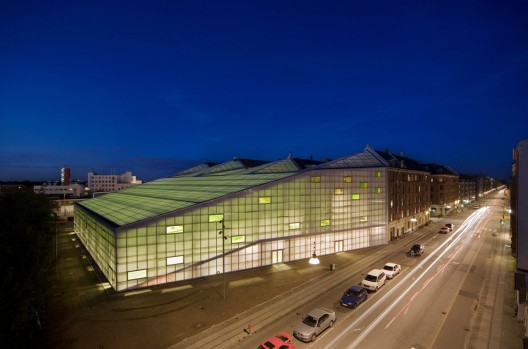
The schemes most pronounced feature is a large translucent membrane that stretches between the sports and culture centre arena, and the four characteristic end walls of the neighbouring public housing scheme.

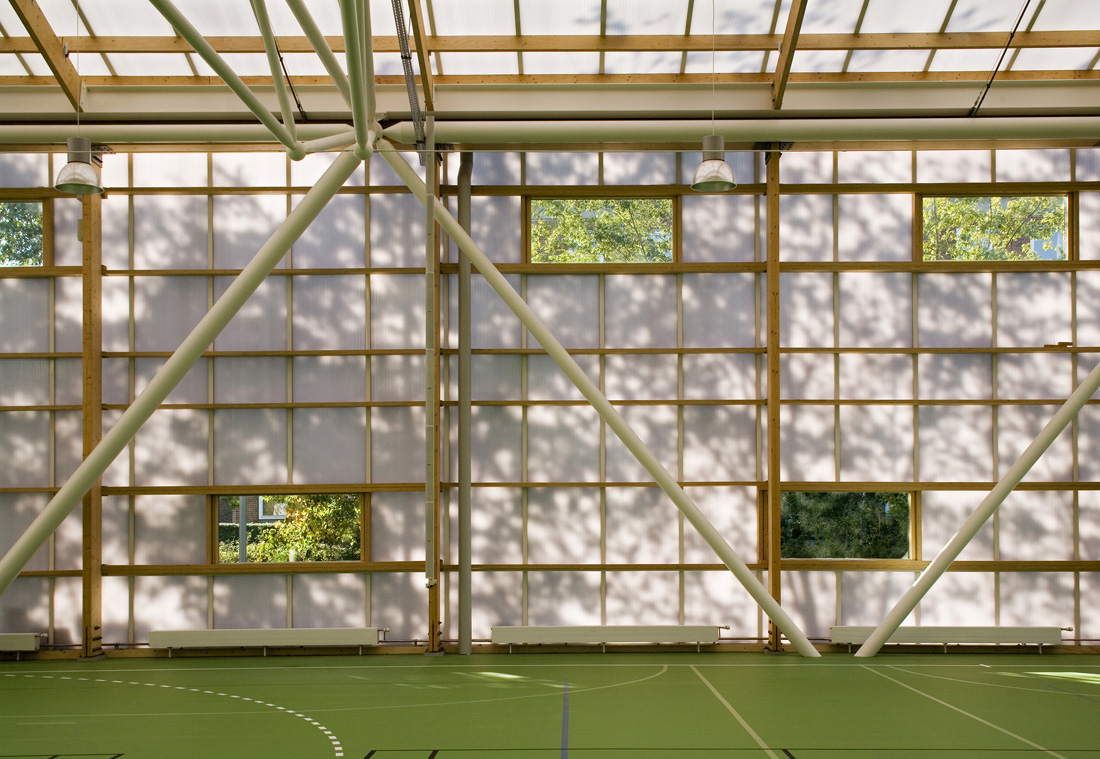
The building´s structure is composed of steel and timber covered with opalescent polycarbonate panels with a low U-value. This translucent cover offers excellent daylight conditions and at night the structure appears as a glowing crystal. The building will be used for a variety of daily sport and cultural activities such as concerts and theatre performances. The dynamic landscape inside allows for various activities to take place on different levels in visual contact with each other.

Saturday, November 22, 2008

White Cave by Takao Shiotsuka Atelier

Architects: Takao Shiotsuka Atelier
Location: Oita, Japan
Client: Private
Project year: 2006-2007
Site area: 419 sqm
Constructed area: 132.6 sqm
Contractor: Hokoku Co. Ltd
Photographs: Toshiyuki YANO (Nacasa & Partners Inc.,)

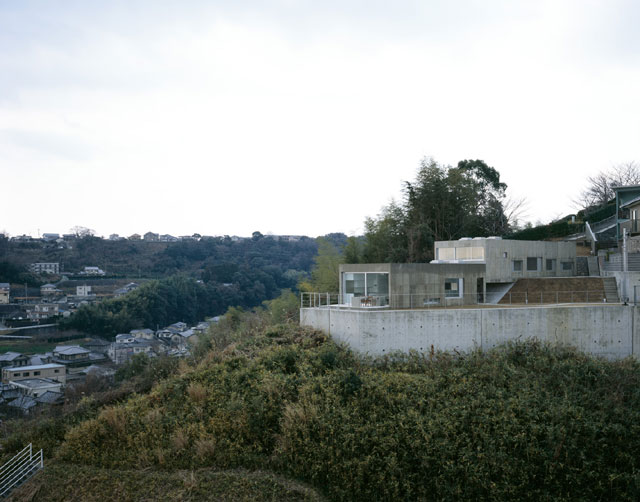
The house is built on a hill looking down at a town area. The site’s shape has an irregular form. There is a height difference of 2m in the site. The north side is adjacent to a neighbor with this height difference. In the west and the south sides trees grow thick right next to the neighbors. And to the East, you can see the town area.
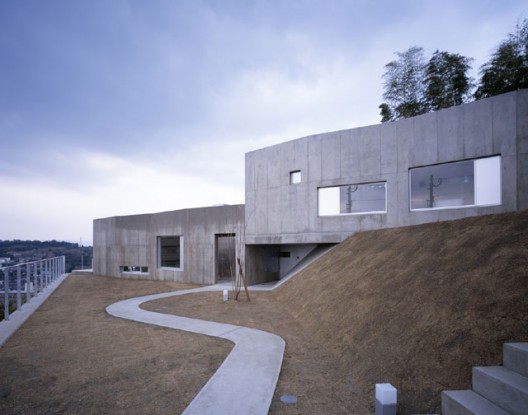
Walking to the site through a path that goes side by side, causes the scenery to change as we walk, and feels very attractive. We arranged the building parallel to the path and saved the height difference inside the volume placed across the site.

We wanted to give the building the same variety as the complex surroundings of the site and its irregular shape, causing disorder but not confusion, on a single operation. The angle of the walls is slightly changed to add more dynamism to the spaces as the user moves. Even the relation with the surroundings, that control and distances views and light, became complex.

The outside walls and the roof have a rough concrete finish, and the openings express the thickness of the concrete that form the volume. We wanted to continue with the characteristic silence of the place, given by the surrounding concrete wall, the ancient burial mounds park and the dense trees. We thought that the appearance of a hard static concrete volume responded to the surroundings of this location.

Organic Wooden House on Seattle’s Skyline by Pb Elemental Architecture

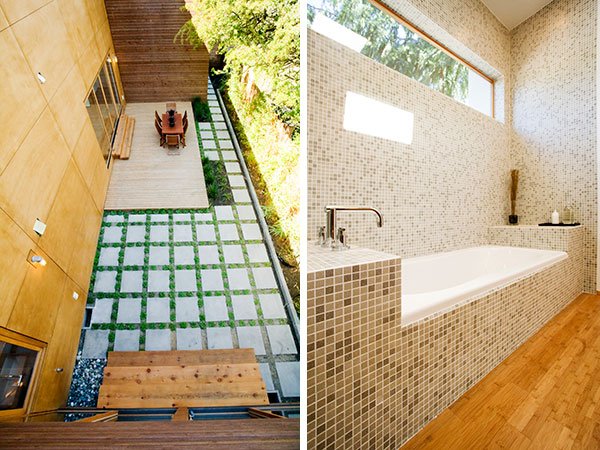
Seattle’s Pb Elemental Architecture is putting an organic notch on the city’s concrete skyline. The Dang Residence is a two-storey private wooden house of 3,600 sq. ft., clad in naturally beautiful cedar. Interiors are divided into a series of modern loft-style living spaces, including three bedrooms, 3.5 baths, a media room and a study. The upper and lower levels are connected by a sky-lit staircase that allows the spill of natural light into the whole of the home. Throughout the house, thoughtfully placed skylights and windows light up corners and crannies, and unique architectural details like art niches. Two balconies and an intimate courtyard at the center of this design embrace outdoor living. Pb Elemental Architecture.

wooden-house-seattle-pb-elemental-architecture-dang.jpg

wooden-house-seattle-pb-elemental-architecture-dang-2.jpg


wooden-house-seattle-pb-elemental-architecture-dang-1.jpg

wooden-house-seattle-pb-elemental-architecture-dang-3.jpg

wooden-house-seattle-pb-elemental-architecture-dang-4.jpg

wooden-house-seattle-pb-elemental-architecture-dang-5.jpg

wooden-house-seattle-pb-elemental-architecture-dang-6.jpg

wooden-house-seattle-pb-elemental-architecture-dang-7.jpg

wooden-house-seattle-pb-elemental-architecture-dang-8.jpg

wooden-house-seattle-pb-elemental-architecture-dang-9.jpg

Friday, November 21, 2008

Exotic Wood Home in Seattle by Pb Elemental Architecture

Dressed to the nines is nature’s finest, this contemporary wood home by Pb Elemental Architecture stands tall among its Seattle surroundings. The exotic Norman Residence is a sleek-looking single-family home clad in three main materials – cedar, glass and hardipanel – which form this natural architectural wonder of 2,647 sq. ft. This modern design occupies a small footprint, but its strong vertical presence makes a bold statement. Thoughtfully placed windows break up the woody facade while flooding interiors with natural light. Interiors, like the home’s exterior, are finished in rich and refined woods. Walls are minimal. A central staircase is the home’s centerpiece awash with warm sunlight. Three bedrooms, a master suite and a “lower-level accessory dwelling” complete this spectacular home design. Pb Elemental Architecture.

wood-home-seattle-pb-elemental-architecture-norman.jpg

wood-home-seattle-pb-elemental-architecture-norman-5.jpg


wood-home-seattle-pb-elemental-architecture-norman-7.jpg

wood-home-seattle-pb-elemental-architecture-norman-6.jpg

wood-home-seattle-pb-elemental-architecture-norman-2.jpg

wood-home-seattle-pb-elemental-architecture-norman-3.jpg

wood-home-seattle-pb-elemental-architecture-norman-4.jpg

wood-home-seattle-pb-elemental-architecture-norman-1.jpg

Thursday, November 20, 2008

Modern Glass House in London Overlooking Historic Victorian Cemetery

You know what they say about people who live in glass houses – those fortunate folks get the best view. In the case of this magnificent, modern glass house by London-based architects Eldridge Smerin, the view is a peaceful one of the historic Victorian-era Highgate Cemetery in London, UK. Notable of this unique, contemporary design is the home’s two contrasting faced. The glazed facade of the house facing towards the cemetery allows light to spill into every corner inside; while the street side of the home boasts a combination black granite, glass and steel. The design is also distinctive for the architect’s innovative incorporation of the outdoors into indoor spaces, the expansive windows being the most obvious. As one passes through the house, the ceiling opens up to reveal an open sky above the top-floor kitchen which is covered with a sliding glass skylight. Below, in the home’s four storeys, spacious living rooms, bedrooms, and gracious entertaining areas are the mark of a truly grand home. The outdoors make their way in through multiple balconies. Individual interior living areas are united through the glass floors, wall panels and frameless doors. Eldridge Smerin
via Dezeen

eldridge-smerin-london-house-1.jpg


eldridge-smerin-london-house-2.jpg

eldridge-smerin-london-house-3.JPG

eldridge-smerin-london-house-4.JPG

eldridge-smerin-london-house-5.JPG

Tuesday, November 18, 2008

Italian Lake House by Marco Castelletti

Italian Lake House by Marco Castelletti

This is truly an impressive Lake House set in Como, Italy. Designed by architect Marco Castelletti, the building incorporates a mix between the vertical design and the horizontal structure. The modern home is built on the slope of a hill with stairs leading up to the top, has an entrance hall that leads to the main hall which faces the lake and houses the living areas and bedrooms. The horizontal column contains the service wing of this Lake House. A serene view, a brilliant amalgamation of Italian design and modern furniture, are just a few things that will charm you. Like it?

Italian Lake House by Marco Castelletti

Italian Lake House by Marco Castelletti

Italian Lake House by Marco Castelletti

Monday, November 17, 2008

Denpasar Residence in Bali

Denpasar Residence in Bali

Not sure about you, but I’m much more into cozy and intimate properties with some green stuff in the area and maybe a pool, rather than large ones with lots of concrete and stuff. Why am I telling you all these? Check out the Denpasar Residence in Bali. Designed by GFAB Architects, this modest home is actually a mix between an older mansion and a newer building proving once again that old is not always bad. The open space with nicely shaped lines, the trees, the swimming pool, a large bedroom that gets an awesome outside view, the modern stairs or the beautiful furniture, don’t need any more words, right? And if you consider this is Bali …

Denpasar Residence in Bali

Denpasar Residence in Bali

Denpasar Residence in Bali

Denpasar Residence in Bali

Denpasar Residence in Bali

Denpasar Residence in Bali

Sunday, November 16, 2008

W Hotel & Residences in New York

W Hotel & Residences in New York

What is it that you expect from new residences or from newly built hotels? High class, isn’t it? Well, in Downtown New York on 123 Washington Street, a 57-storey tower designed by Gwathmey Siegel Architects is going to be built and should most likely meet the above criteria. Dubbed the W Hotel & Residences and with the help of interior designers from GRAFT, the hotel rooms and the flats are really astonishing. With Great large windows that offer great views over the city, extremely modern furniture and top notch furnishings. I just can’t choose the best picture of the ones you’ll see below, but that’d definitely be the apartment of my dreams if I were to buy one. Wonder what the prices will be over there.

W Hotel & Residences in New York

W Hotel & Residences in New York

W Hotel & Residences in New York

W Hotel & Residences in New York

W Hotel & Residences in New York

Contemporary House in Japan by Curiosity Inc. - C-2

For curiosities and architectural oddities, the aptly names Curiosity Inc. delivers with some unique modern residential designs, like C-2 House in Yamanashi, Japan. This cool house design is characteristic for its contemporary facade which comes to a peak – literally and figuratively – with a unique shape. The home’s exterior carries a retro quality, clad in dark-stained cedar shakes and bright-white slabs, while interiors are cleanly contemporary with a minimalist feel that follows the sharp angles of a distinctive roofline. The home’s unconventional entrance welcomes you into an open hallway that leads through the house and out the opposite end. Floor-to-ceiling windows bring you back to nature, revealing a splendid view of earth and trees.


Contemporary House in Japan by Curiosity Inc. - C-2


Contemporary House in Japan by Curiosity Inc. - C-2


Contemporary House in Japan by Curiosity Inc. - C-2


Contemporary House in Japan by Curiosity Inc. - C-2


Contemporary House in Japan by Curiosity Inc. - C-2


Contemporary House in Japan by Curiosity Inc. - C-2

Friday, November 14, 2008

Contemporary House in Amsterdam with Modern Vertical Garden

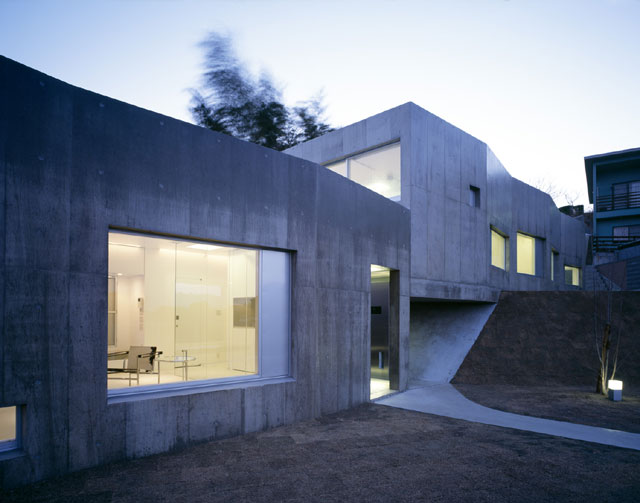
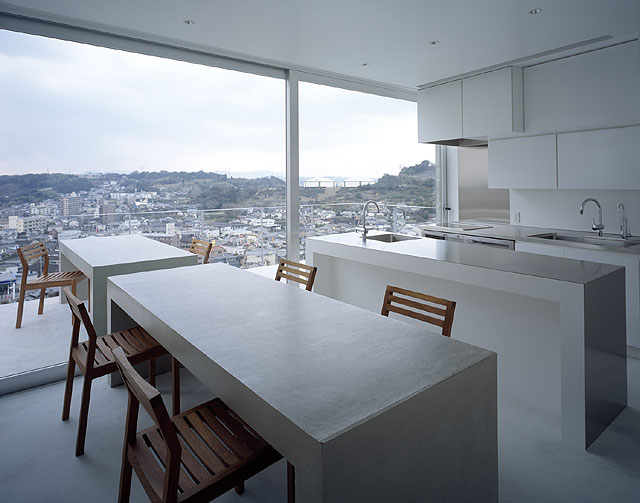
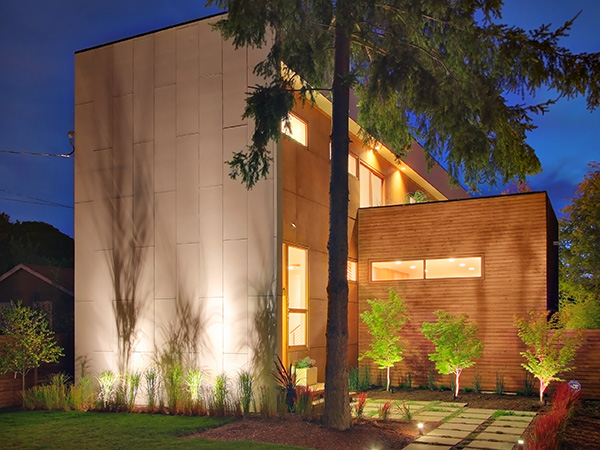
Beautifully blending architecture with nature, this contemporary house by Marc Koehler Architects was designed as a vertical garden in a concrete jungle. The house in IJburg, Amsterdam, features various spaces seemingly “carved out” from a “monolithic sculptural mass” in a series of open and private spaces, as described by the architect, which unifies all elements of this contemporary design – the exterior, interior, and of course, the unique vertical garden and large rooftop terrace. The facade incorporates brick work for visual interest as well as to accommodate growing greenery. Interiors are bright with natural light. The contemporary layout features a main floor housing three bedrooms, a bathroom, a powder room and a large multi-purpose space. Upstairs, a kitchen, dining area and large living area offer views of the surrounding city and garden just outside the expansive windows. Marc Koehler Architects.
ijburg-house-1.jpg

ijburg-house-2.jpg

ijburg-house-3.jpg

ijburg-house-4.jpg

ijburg-house-5.jpg

ijburg-house-6.jpg

ijburg-house-7.jpg

ijburg-house-8.jpg

Thursday, November 13, 2008

Modern Sustainable Home in UK - Repurposing and Revitalizing the 1890s Railway Carriage

Like an animal adapts to its environment, so too does this modern repurposed rail carriage on Dungeness Beach in Kent, UK. Designed by architect Simon Conder, El Ray is a modern home designed to both blend into its sandy surroundings and weather their storms. The two-bedroom house is a restoration and reformation of a railway carriage circa 1890 sits at the heart of the home, now transformed into the home’s main hub – the kitchen. A sloping roof invites visitors to revel in the breathtaking view that is the sea. One elevation takes on a semi-circular form, while facing south is a fully-glazed facade overlooks the Channel. The architect used FSC-certified wood where possible, making it a sustainable choice. Adding to the eco-friendly appeal, this modern house design also incorporates passive solar power, cross ventilation and wind turbines as a source of natural heating, cooling and off-the-grid power. Simon Conder.

Read the full article by Graham Bizley for Building Design magazine.

el-ray-house-1.jpg

el-ray-house-2.jpg

el-ray-house-3.jpg

el-ray-house-4.jpg

el-ray-house-6.jpg

el-ray-house-7.jpg

Wednesday, November 12, 2008

Abu Dhabi’s Twin Eco Towers are LEED Platinum

As the world fights to take a grasp of the global financial situation, the Middle East churns out one big construction project after the other. The Leed Platinum Twin Eco Towers to be built in Abu Dhabi was revealed during Cityscape last week.

The 23 storey building - supposedly known as the Eco Towers will be built with a Leed Platinum certification and is being structured by Connection Real Estate for a budget of $245 million. The two towers, one of which will be for commercial use while the other will be used for residential purposes, will be built on a pedestal housing a grand shopping plaza.

Solar power, air purification systems, natural green terraces, toxic free materials, effective insulation, an abundance of natural light, easy access to several local services and many more exceptional features will give the Twin Towers a perfect quality LEED certificate. The project is another step towards the green revolution and I must say it looks amazing. - via JetsonGreen

Tuesday, November 11, 2008

Lighthouse by Potton: First Net-Zero Carbon Self-Built Home

Do you remember the first zero-emission house that was released more than a year ago in UK? Today I hear that the same guys (the Brits) will get the first net-zero carbon house, that reaches the highest level of sustainability. Dubbed the Lighthouse, the highly eco-friendly house was designed by Potton and was meant to “encourage a way of living that is inherently ‘light’ on the world’s resources whilst combining the practicalities of today’s average homeowner.”

It sits on screw piled foundations (raised from the ground to minimize impact), features a sloping 40-degree roof that captures wind for cooling and ventilation, has triple glazed large windowsto reduce heat loss and also packs photovoltaic panels and built-in systems that would recycle rainwater. Not sure how eco-conscious people are, but I’m glad that a net-zero carbon self built home exists.

Monday, November 10, 2008

Modern White Sea House

No, the Japanese are not only good with Sushi and electronics. Apparently they also have great designers and architects or at least that’s how I jump to conclusions after seeing thie modern white sea house. It was put up by Takao Shiotsuka Atelier in Japan and is a 237 sq m two-floors white buildng with a shape that spreads gently towards the sea. Painted in white, with extremely large windows that allow sun-rays inside and a modern but minimalist interior, it’s a stunning piece of design. If I were to change something, that would be a little bit of contrast … it’s too whitey, don’t you think? How about some black and red shapes? - Source

Kanno Museum by Atelier Hitoshi Abe

Located in a small town of Shiogama, Japan, with a view of the Pacific Ocean, Atelier Hitoshi Abe designed a private art museum intended to permanently display eight sculptures owned by the client.

Rather than a white cube able to accommodate any type of exhibition, they aimed to design a unique landscape, and specific places for exhibiting each of the sculptures.

Within the predetermined 10×12x10 meter volume, the architecture was given form by creating the eight spaces as if inflating them like soap bubbles. This form is defined by balancing the conditions that give rise to the boundary surfaces of each cell, which are formed by the internal pressures of the small spaces within the large space of the entire building.

Visitors may experience the eight sculptures while moving around the cells.

Modular home MoMo

modular-home-momo

The MoMo is a highly flexible, modular home concept. This modern prefab home can be adapted to the site conditions and the dwellers individual needs without compromising architectural or functional qualities

Designed by Swedish architect Thomas Lind, this modular home was planned with natural, high quality materials in mind, offering a healthy living environment including a green roof, a traditional stained wood construction and whitewashed interiors.

modular-home-momo

modular-home-momo

modular-home-momo

Available in flat packs, each base model of this modular home can be extended and combined in a variety of ways - available in seven sizes for you to choose from, from 40 square meter to 110 square meter.

modular-home-momo

modular-home-momo

Amazon Treehouse

amazon-treehouse

I came across yet another tree house company called Amazon Treehouses and what I particularly love about their tree house design is that it’s magical, almost as if taken from a fairytale.

An inspirational secluded haven you always dreamed of or an amazing focal point for your garden - Just let your imagination run wild and take it to a higher level, sort of speak. As I saw those treehouse pictures I was completely taken, I mean these treehouses are beautiful and the locations, OMG…

amazon-treehouse

amazon-treehouse

amazon-treehouse

amazon-treehouse

Made for children and adults alike and with prices ranging from 5,000 through to 100,000+, these unique treehouses are designed for domestic use as well as hotels, eco-tourism resorts and more.

amazon-treehouse

…winter wonderland…

amazon-treehouse

White Apartment / Parasite Studio

Architects: Parasite Studio
Location: Timisoara, Romania
Project Team: Baldea Maja, Wneczel Attila, Toma Claudiu
Project year: 2007
Constructed area: 150 sqm
Photographs: Andrei Margulescu & Magazine Architectura

The apartment is located on the first floor of a building raised in the last century in the central area of Timisoara, within an area of protected buildings.

From the first design sketches we tried to get distance from the interventions that have become „standard procedures” in the local scene of designing within old buildings. The owner, a jazz passionate, wished for an elegant and flexible apartment of high standard, with vast multifunctional areas within the living space. The apartment was supposed to serve the needs of a single family.

The design we settled upon was an intervention where the white color is dominant and plays the role of a clean and immaculate background on which the main theme of the apartment is evolving - the furniture, which is treated as a unitary contemporary insertion. The effect of the interior design is based on the contrasts between support/insertion, old/new, permanent/temporary. The basic themes of the design are the rhythm of the paneling of the furniture pieces, the cuts and the cut-outs within them that follow the rhythm and the modulations of an idea of musicality.

The furniture and partition units define areas and organize the space, ordering the whole display of activities. By its design, the furniture overcomes its state of static object within space and takes part in a dynamic manner in the definition of the apartment.

From the former structure of the apartment we maintained as a main feature the dynamic longitudinal wall that separated the two living areas (diurnal/nocturnal) - a structural element that integrated niches for depositing and passages. It is “wrapped” in the new furniture and transformed into a functional volume that takes part in the interior definition of space, a contained that plays the role of a space divider.

The initial configuration of the apartment is almost entirely maintained. The original woodwork and metalwork are entirely refurbished and integrated within the concept, endowed with a contemporary “plastic” materiality. Also the wood parquet was maintained and treated as a valuable feature of the apartment that tempers the new intervention and confers “warmth” to the living areas. The general appearance of “septic” white is counterbalanced by the paneling, the color of the niches, the lighting units integrated in the furniture and the personal objects of the owners.

La Peña Multi-Sport Pavillion / Coll-Barreu Arquitectos

Architects: Coll-Barreu Arquitectos - Juan Coll-Barreu & Daniel Gutiérrez Zarza
Location: Bilbao, Spain
Client: Bilbao Council
Project year: 2002-2003
Construction year: 2004-2006
Constructed area: 10,350 sqm
Budget: 5,663,020 EURO (US $7,7M)
Contractor: UTE Albatros, Olábarri
Photographs: Aleix Bagué

The lot is a reduced and irregular piece of terrain, almost residual, that opens a way between the rear and unaligned facades´ heights of a a group of housings and the almost vertical wall of a natural hillside, in which there are many train tracks and highways. A new commuter train station and the metallic structure of the existent pediment determine the extremes of the lot and generate different slopes.

situation plan

The sports complex is an uneven volume that complies with multiple conditions that coexist in the lot. A semitransparent fencing of black concrete and glass tries to respond to the different situations generated between the transforming residential city and natural hillside profoundly affected by industrialization.

The building generates small exterior spaces and empty interior ones to adapt itself to the complexity of the environment, to organize the accesses, to capture the natural light and to express to the users the vertical functioning of the project.

The implicit option of the project is a bare, unitary sports complex to host physical activities, which is open to the transformed nature and to the changing city.

Thursday, November 6, 2008

House II in Aroeira by ARX

Architects: ARX PORTUGAL - José Mateus y Nuno Mateus
Location: Caparica, Portugal
Project team: Paulo Rocha, Stefano Riva, Andreia Tomé, Marco Roque Antunes, Pedro Sousa, Tânia Pedro
Project year: 2000- 2003
Construction year: 2004- 2007
Constructed area: 640 sqm
Structure: SAFRE, Projectos e Estudos de Engenharia Lda.
Photographs: Telmo MillerThis is the second project for the urbanization of the Aroeira’s golf course, a field of lawns, sand zones and lakes, and in this case, also a pine tree area. The terrain is narrow and long, slightly triangulated and with a soft inclination alongside the lot. It is also densely occupied by large pines, which end suddenly at north by the immediate vicinity of the golf course.

The house consists on three continuous bodies, articulated by two patios. The first body, a ground floor, is longitudinal to the entrance and is used as garage and working area. The second is transversal and comprises the common life of the house, the kitchen and living-rooms, overlapped in two storeys, opening up to the landscape. The last one is once again longitudinal and a one-floor body, now in suspension, and comprises the bedroom area.

The two patios are layered in white manufactured tile, the first one destined to a service usage and the second one, of double height, complements the living-room ambiance with a gardened mirror pool.

The house design has specially centred on the relationship it establishes with the topography and the distant landscape.

It has assumed a serpentine shape, sliding across the slope, leaning whether to one longitudinal limit or the other, therefore assuring privacy where needed and allowing the enjoyment of the landscape when wanted.
At the same time the natural curve of land goes down, the roof goes up, and the house shifts from a ground-based situation to a floating one, supported by the delicate metal columns and drawing a trail across the garden down to the pool.

Saturday, November 1, 2008

EDITT Tower - Singapore Goes Eco-Friendly

What, you though only Dubai and China have the most stunning buildings in the world? Guess again, because EDITT Tower (“Ecological Design In The Tropics”) will be built in Singapore with the financial support of their National University and should be the most eco-friendly in the country. The most interesting thing is that this 26-storey building will use photovotaic panels and will be wrapped in organic local vegetation that will act as a living wall insulator. More to it, the skyscraper was designed to collect rain-water, both for plant irrigation and for its “needs”. If you want to congratulate someone, T.R.Hamzah & Yeang have had their hands on the project. They’re responsible with the pictures below.

Rotating UFO-Homes: Solaleya Domes

If you guys are into science fiction here’s something for you. Apparently a company called Solaleya is buidling rotating UFO-homes. Even though I would have expected them to fly do a looping or some other aerobatic maneuvers, I’m good with knowing that it’s a highly sustainable and eco-friendly house. It has a small mechanical structure in the base that gently rotates it to make sure those solar panels on the roof are getting the most sun energy.

Back to bing serious, the Solaleya Domes are made of FSC-certified wood, are insulated with cork and have a structure that will withstand category 5 hurricanes and earthquakes up to magnitude 8 on the MSK scale (in case you wondered). Wouldn’t it be cool to lift off when a hurricane is being announced? You betcha! - via Inhabitat

China’s Huaxi Urban Center

The first thing that I thought of, when looking at these pictures, was what sheik in Dubai owns this stunning building. But reading further I realized that - surprisingly - it’s going to emerge in China. Dubbed the Huaxi Urban Center, the exterior of the building was ingeniously designed to hide its massive network of support beams, duct work, wiring, and HIVAC systems. It uses flexible cellular based materials, exoskeletal lattices, and carbon fiber composites which are all highly advanced and needed to put up something like that.

I simply love the way they play with lights (red, yellow, light blue and light green) but still, I can’t say that building is gorgeous. That’s because it’s astonishing and mind-blowing.